
Traffic noise can make living in an otherwise comfortable home unpleasant, particularly when bedrooms face a busy road. Homeowners often look for ways to reduce traffic noise inside their home, but choosing the right solution requires understanding how sound travels through the building envelope.
More...
A recent project in Toronto illustrates how an acoustical consultant can identify the weakest parts of a building's exterior construction and recommend improvements based on engineering analysis rather than guesswork.
The problem: Traffic noise entering the bedrooms
The homeowner contacted me about traffic noise from a major arterial road about 100 metres from his custom-built house. His primary concern was noise entering the bedrooms facing the road.
The house was constructed in 2017 and appeared to have relatively substantial exterior walls, consisting of brick veneer, sheathing, insulated 2 × 6 wood framing, a vapour barrier and interior drywall. The roof had a tall, insulated attic.
The windows, however, were different. The bedrooms had conventional vinyl casement windows with relatively narrow spacing between the glass panes.
This difference in construction was important. Even when exterior walls provide good sound insulation, relatively lightweight windows can become the dominant path for traffic noise entering a house.
Why identifying the weakest component matters
An exterior wall is not acoustically equivalent to a window. A wall may have substantially better sound insulation than the window installed in it.
For this project, I used the INSUL acoustic simulation program to estimate the sound insulation performance of the existing construction.
The estimated performance was:
The results indicated that the windows were the acoustically weakest components of the building envelope.
This is an important principle in soundproofing: improving an already effective wall or roof is unlikely to produce a substantial improvement if most of the noise enters through the windows.
An effective soundproofing strategy must address the dominant transmission paths, not simply add more insulation wherever it is convenient.
Why STC alone is not enough for traffic noise
Another important part of this assessment was selecting the appropriate acoustic rating.
The Sound Transmission Class (STC) is widely used to describe the sound insulation of building assemblies. However, STC is not specifically designed to characterize the transmission of outdoor noise, particularly low-frequency traffic noise.
For this reason, I also considered the Outdoor-Indoor Transmission Class (OITC).
OITC is particularly relevant when assessing building façades exposed to transportation noise, including road traffic. It gives greater consideration to lower-frequency sound than the conventional STC rating.
This distinction matters because traffic noise contains substantial low-frequency energy. A window with a seemingly respectable STC rating may still provide inadequate protection against traffic noise.
An acoustical consultant must therefore understand what the different ratings represent and select the rating appropriate to the actual noise source.
The proposed solution: Secondary acoustic window inserts
Rather than recommending a full window replacement, I evaluated secondary acoustic window inserts from bQuiet, an excellent noise-reducing option.
These inserts create an additional glazing layer inside the existing window. The airspace between the original window and the insert is an important part of the acoustic design.
Using INSUL, I compared the estimated sound transmission loss of the existing windows with the performance of the combined window assembly incorporating bQuiet acoustic window inserts.
The simulation indicated the following approximate ratings:
Window configuration |
|
| ||
|---|---|---|---|---|
Existing casement window | 28 | 22 | ||
Existing window with acoustic insert | 43 | 30 |
The estimates assumed an airspace of approximately 67 mm (2.5 inches) between the existing window and the insert. Where practical, increasing this spacing may further improve sound insulation.
The predicted improvement was approximately 15 STC points and 8 OITC points.
These are substantial improvements, although they do not mean that all traffic noise will disappear.
Why low-frequency performance must be examined
One particularly important finding emerged from the frequency-by-frequency analysis.
Although the simulation predicted substantial improvement over much of the frequency range, it indicated little or no improvement between approximately 50 and 125 Hz, as illustrated in Figure 1.
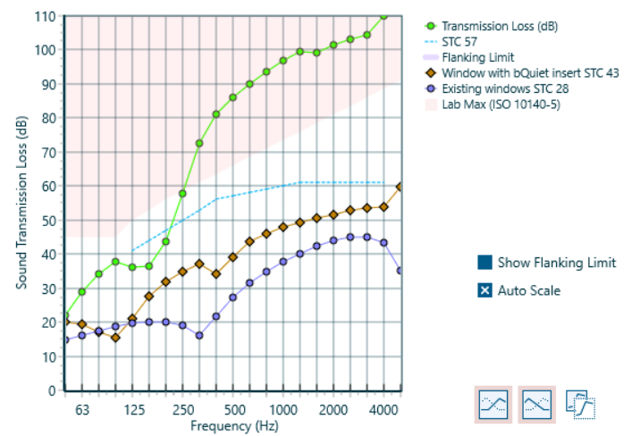
LEGEND:
Blue line – existing windows, STC 28
Orange line – existing window with bQuiet insert, STC 43
Green line – existing exterior wall, STC 57
Figure 1 – Comparative sound transmission loss, frequency characteristics
This is significant because road traffic can contain considerable low-frequency noise, particularly from heavy vehicles.
The physical behaviour of the two glazing layers and the airspace between them can limit sound insulation at certain low frequencies. Simply adding another layer of glass does not guarantee improved performance at every frequency.
This is precisely why an acoustical assessment should not rely exclusively on a single STC or OITC number.
Examining the frequency characteristics of the proposed assembly helps identify both its benefits and its limitations. It also allows the homeowner to make an informed decision about what improvement to expect.
What improvement can the homeowner expect?
Based on the OITC ratings, the predicted improvement in transportation-noise insulation was approximately 8 dB.
A 10 dB reduction is commonly associated with halving perceived loudness. An 8 dB reduction would therefore represent a substantial subjective improvement, although the actual perception depends on the character of the noise and the background sound level.
For illustration, if the outdoor traffic noise level were 65 dBA, applying the OITC ratings as a simplified attenuation estimate would produce the following comparison:
Condition | Illustrative sound level |
|---|---|
Outdoor traffic noise | 65 dBA |
Through existing windows | 43 dBA |
Through upgraded windows | 35 dBA |
Predicted improvement | 8 dB |
These figures illustrate the relative improvement, not guaranteed indoor noise levels. Actual indoor levels depend on several factors, including window dimensions, room absorption, the sound insulation of other exterior surfaces, installation quality and the characteristics of the traffic noise.
Why professional acoustical advice is valuable
Homeowners can find many soundproofing products advertised online. However, selecting a product based solely on promotional claims or a published STC rating can lead to disappointing results.
An experienced acoustical consultant brings several important capabilities to a project:
- 1Identifying the dominant noise paths. The weakest part of the building envelope is not always obvious. A consultant evaluates the relative sound insulation of windows, walls, roofs and other building components.
- 2Selecting appropriate acoustic criteria. Different noise sources require different assessment methods. Traffic noise should not be evaluated using STC alone.
- 3Analyzing frequency-dependent performance. Sound insulation varies with frequency. A product may perform very well in one frequency range but provide limited improvement in another.
- 4Evaluating proposed solutions. Acoustic simulation can help compare alternatives before the homeowner commits to expensive construction or window replacement.
- 5Explaining realistic expectations. No soundproofing system is perfect. A professional assessment should identify expected benefits and limitations.
In this case, the analysis identified the bedroom windows as the principal weakness and supported a practical improvement using secondary acoustic window inserts rather than unnecessary modifications to the walls or roof.
Conclusion
Effective soundproofing begins with understanding how sound enters a building. It is not simply a matter of buying a product advertised as soundproofing material.
An acoustical consultant can identify the dominant transmission paths, evaluate the existing construction, compare potential solutions and estimate their likely performance.
The objective is not to promise complete silence. It is to recommend technically appropriate improvements that address the actual noise problem and set realistic expectations for the homeowner.
Before investing in soundproofing, consider obtaining an independent acoustical assessment. A relatively modest consulting fee can help you avoid expensive work that doesn't solve the problem.


